
Commercial vs Residential Property investment in India has historically been the safest and most preferred asset class for smart investors. However, the market dynamics have shifted drastically as we approach 2026. The traditional strategy of purchasing a flat, putting it on rent, and passively waiting for capital appreciation is becoming outdated. Today’s smart investor is focused on raw data, analytical models, and, most importantly, consistent cash flow.
If you have the capital and are actively seeking maximum market returns, the most critical question you will face is: Residential vs Commercial Property Investment in India—which avenue truly maximizes your hard-earned money? In this comprehensive 2026 guide, we will decode the facts, ROI metrics, real-life case studies, and the latest market trends to help you make a highly profitable decision.
The Core Difference: Understanding Purpose and Mindset
Before you deploy a single rupee, it is crucial to understand the fundamental nature of the asset you are buying. Both property classes are engineered for completely different investor profiles.
[H3] Residential Real Estate: The Emotional Asset. This category includes properties designed strictly for living—such as apartments, builder floors, villas, and residential plots. In India, residential real estate is heavily driven by emotion and a sense of personal security. Everyone wants a “dream home.” From an investor’s perspective, the entry barriers are relatively low, and housing loans are easily accessible through major financial institutions at lower interest rates.
[H3] Commercial Real Estate: The Logical Asset.

This includes office buildings, retail, high-street shops, warehouses, and IT parks. Commercial real estate is driven solely by numbers, logic, and the potential for business. In this case, your “tenant” is a business or corporation with the sole purpose of generating revenue from that physical location, and there is no emotional attachment; it is a pure profit-driven transaction. Professional investors purchase all of their investments based on the economic characteristics of the property, i.e., rental yield, quality of tenant, length of lease lock-in, while all novice real estate investors make their decisions primarily on emotional and aesthetic considerations.
Commercial vs Residential Property: The Ultimate ROI Test
For any investor, the most important things to think about are Return On Investment and Rental Yield. This is how much rent you get per year compared to the value of the property. Let us look at the difference in commercial and residential real estate Return On Investment.
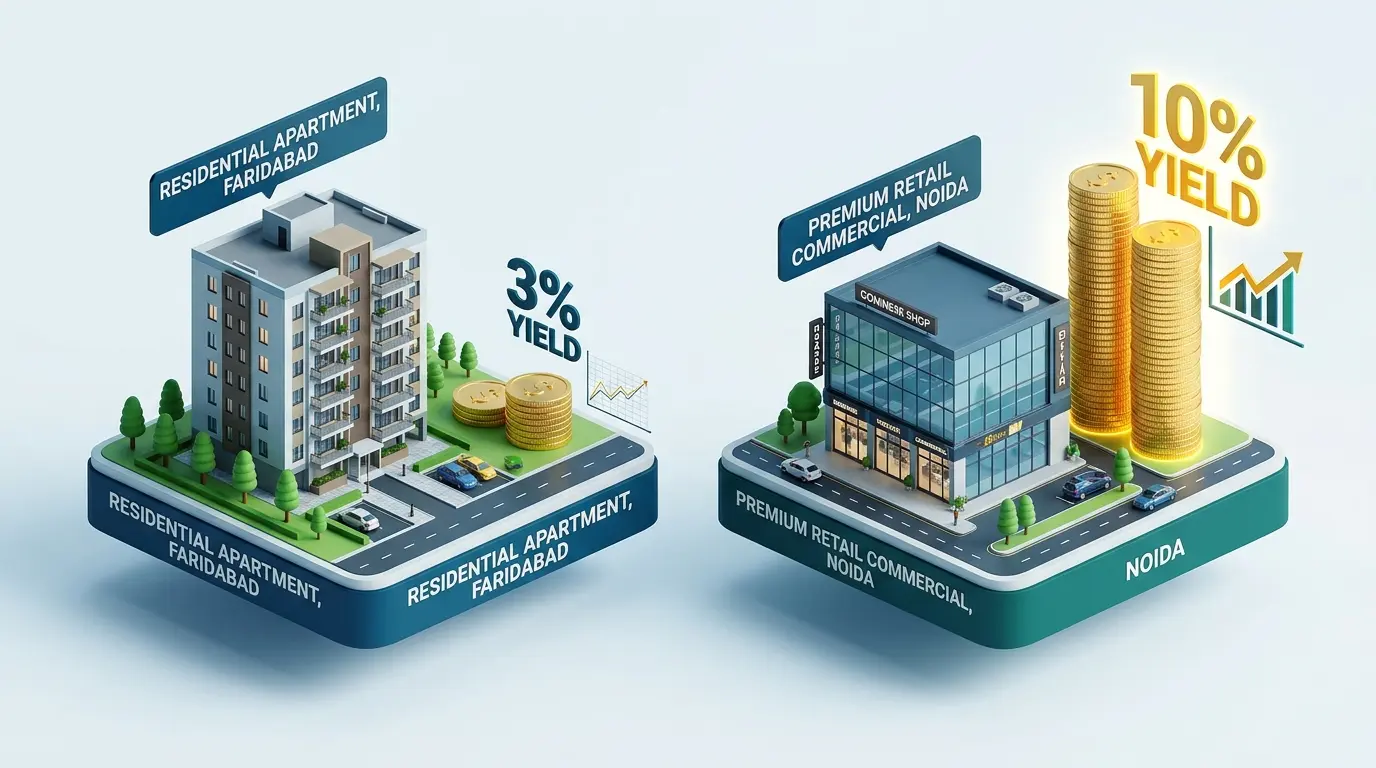
The Residential Reality is that you get a yield of 2 percent to 3 percent. In cities like Delhi NCR, Faridabad, Mumbai, or Bangalore, the average rental yield for residential properties is between 2 percent and 3 percent. If you buy a 3-bedroom apartment in Delhi NCR, Faridabad, Mumbai, or Bangalore for ₹1 crore, you will get around ₹2.5 Lakhs to ₹3 Lakhs per year as rent. This is ₹20,000 to ₹25,000 per month. The main way to make money in real estate is to hold the property for 10 to 15 years with HRrealtech and then sell it when the land price goes up.
The Commercial Advantage is a difference. Commercial properties give you a yield of 8 percent to 10 percent. Sometimes you can even get up to 12 percent in good business areas. This means that if you buy a shop or office space for ₹1 Crore, you can get ₹8 Lakhs to ₹10 Lakhs per year as rent. This is ₹65,000 to ₹85,000 per month. Commercial real estate is a game-changer for people who want to make money from rent. Commercial real estate gives you a higher Return on Investment compared to residential real estate.
Real-Life Data: The Faridabad vs Noida Micro-Case Study
Let’s step away from generic theories and look at actual numbers happening right now in the Delhi NCR region. What happens if you have a budget of ₹1 Crore to invest today?
| Investment Parameter | Residential Option | Commercial Option |
| Location Example | 3BHK in Neharpar, Faridabad | Retail Shop in Sector 18/62, Noida |
| Total Investment | ₹1 Crore | ₹1 Crore |
| Average Monthly Rent | ₹22,000 | ₹80,000 |
| Annual Cash Flow | ₹2,64,000 | ₹9,60,000 |
| Tenant Volatility | High (Changes every 11 to 24 months) | Low (Corporate lock-in for 5 to 9 years) |
| Maintenance Burden | Paid by Owner (Plumbing, paints, etc.) | Paid by Tenant (Corporate CAM charges) |
The Case Study Verdict: While the Faridabad residential apartment will give you steady land appreciation over a 10-year horizon, the Noida commercial shop will generate massive, passive cash flow immediately, recovering your initial investment much faster through rent alone.
[H2] Overcoming the 2026 Entry Barrier: Capital Requirements
There is a persistent myth in the Indian market that commercial real estate requires an exorbitant ₹5-10 Crore corpus. In 2026, this is no longer accurate due to new financial models.
[H3] The Traditional Market Approach: In the residential sector, you can secure a property with just a 10% to 20% down payment. You can effectively enter the market with ₹20 Lakhs in cash and finance the rest through a home loan. Conversely, acquiring independent high-street commercial shops traditionally requires substantial upfront capital, and commercial loan interest rates are notably higher.
The 2026 Game Changer: Fractional Ownership. If you are seeking high-yield, affordable entry points, ‘Fractional Ownership’ is booming in 2026. How does it work? A massive ₹50 Crore Grade-A office building is divided into smaller investment shares. You can now become a legal co-owner in premium commercial real estate with an investment of just ₹10 Lakhs to ₹25 Lakhs. You receive your proportionate share of the 8-10% rental yield directly into your bank account, enjoying corporate-level returns without buying the whole building.
Tenant Management, Legalities, and Lease Structures
Acquiring a property is only the first step; managing the asset and the tenant is where the real work begins.
1. Lease Duration and Vacancy Risk: Residential leases are typically formulated for 11 months. Tenants can vacate with minimal notice (usually one month). This exposes you to frequent vacancy risks—months where the property sits empty, generating zero income while you still pay maintenance. Commercial properties, however, operate on stringent “Lock-in Periods.” Leases extend anywhere from 3 to 9 years. If a corporate tenant breaks the lease early, they are legally bound to pay massive penalties. This guarantees a stable, long-term revenue stream.
2. Maintenance and Wear-and-Tear: In residential properties, the financial burden of plumbing, electrical faults, seepage, and standard wear-and-tear falls entirely on the owner. You will frequently receive calls from tenants to fix minor issues. In commercial real estate, the space is usually handed over as a “bare shell.” The corporate tenant spends their own money on interior fit-outs. Furthermore, Common Area Maintenance (CAM) charges are paid by the tenant. You simply receive a fixed monthly cheque without the operational headaches.
Assessing The Risk Factor: What Can Go Wrong?
Understanding your risk appetite is non-negotiable. If we evaluate the exact risk profile of Residential vs Commercial Property Investment in India, here is what you need to know:
Tenant Management, Legalities and Lease Structures
Buying a property is the beginning. The real work starts when you have to manage the property and the tenant.
1. Lease Duration and Vacancy Risk: Usually, residential leases are for 11 months. Tenants can leave with little notice, which is usually one month. This means you have to deal with the risk of the property being empty for months, which means you get no income from it. You still have to pay for maintenance. On the other hand, commercial properties have strict rules about how long the lease is. These leases can be from 3 to 9 years. If a company tenant breaks the lease early, they have to pay a lot of money as a penalty. This means you can expect to get an income for a long time.
2. Maintenance and Wear-and-Tear: When it comes to properties, the owner has to pay for things like plumbing and electrical problems, water damage, and normal wear and tear. You will get a lot of calls from tenants to fix issues. With commercial real estate, the space is usually given to the tenant as an empty shell. The company tenant spends its money to make the space usable. Also, the tenant pays for maintenance of the areas. You just get a fixed amount of money every month without having to worry about the day-to-day problems.
Assessing The Risk Factor: What Can Go Wrong?
You have to know how much risk you are willing to take. If we look at the risks of investing in residential versus commercial properties in India, here is what you need to know: Tenant Management and Lease Structures are very important. Tenant Management and Lease Structures can break your investment. You have to understand the risks of Tenant Management and Lease Structures.
- Why Residential is Safer: Housing is a fundamental human necessity. Regardless of stock market crashes or economic recessions, the demand for housing never drops to zero. If you face a financial emergency and require immediate cash liquidity, residential assets are significantly easier to sell in the open market within a few weeks.
- Why Commercial is Risky: Commercial real estate is tied directly to the broader macro-economy. If there is a recession or a trend of “Work from Home,” businesses shut down offices. In a sluggish market, finding a new corporate tenant for a large office space can take anywhere from 6 to 12 months. During this empty period, the asset becomes a liability, as you still have to pay hefty building maintenance charges out of your own pocket.
Conclusion: Best Commercial vs Residential Property for Rental Income
So, what is the final verdict? The answer is strictly dictated by your age, your financial infrastructure, and your long-term wealth goals.
You should choose Residential Property if:
- You are a novice investor buying your very first property.
- You require a low-risk, highly liquid asset.
- You plan to potentially move into the property yourself in the future.
- You are primarily focused on long-term land appreciation rather than immediate, high monthly cash flow.
You should choose Commercial Property if:
- You possess a higher capital base or are comfortable leveraging fractional ownership platforms.
- You demand aggressive, high-ticket monthly cash flow to replace your active salary.
- You prefer long-term corporate lease structures that free you from daily tenant management and repair dramas.
If your primary objective is strictly building massive passive wealth and cash flow, there is no debate: commercial real estate is definitively the best property investment for rental income in 2026. However, without the right location, a credible RERA-approved builder, and rigorous legal due diligence, your capital is at severe risk in either sector.
Ready to Invest Wisely? Do not leave your wealth generation to guesswork. A single wrong investment can trap your capital for a decade. If you want to bypass the market clutter and identify a data-backed, high-ROI property tailored strictly to your budget, consult with our real estate investment experts today. We will analyze your portfolio and guide you toward assets that actually pay you back.
[Contact Us Today to Book Your Free Real Estate Strategy Consultation]
Great content! Keep up the good work!